Guitar Chords
A chord is a group of three or more notes sounding simultaneously, though they can be also found in 'arpeggio' or 'broken' form, where the notes are played separately, yet still considered as part of a chord. Chords are present in many musical traditions of the world, and constitute an important branch of study in western music. They are the most common means of accompaniment for the guitar.
On the How to play chords section you'll find all the information you need to be able to follow any song, from the very basic open chords to the most difficult barred ones: you'll learn everything about dominant seventh chords, suspended chords, power chords, and how and when to use those. On the Chord Theory section you'll find what lies behind those names, and how to better understand what you are playing.
How to play chords / How to read chord boxes
Chord boxes are diagrams that show which strings to stop, and where to stop them, to play any specific chord. They represent the neck of the guitar, with each vertical line representing one string. The line on the furthest left represents the sixth string, the one next to it the fifth, and so on. Unless indicated otherwise, the line at the top of the diagram represents the nut.
Interpreting chord boxes is pretty simple: each line represents a fret. Dots are drawn where the fingers are supposed to rest. If a string is to be played without stopping it, it is marked with the symbol O. If, however, the symbol X appears next to the string, it is understood that it should be muted or avoided.
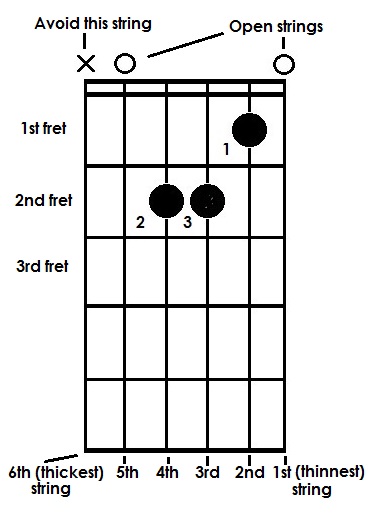
Sometimes, each dot will be labeled with a number, representing the finger which should be used. For these purposes, left hand fingers are referred to as 1, 2, 3, and 4 (index, middle, ring, and little, respectively).